First Results from EriCa Reactor: Funding, Pilots and Continued Collaboration
What can happen in five months when deep tech teams work directly with industry experts, investors and other startups?
The first EriCa Reactor cohort gives some early answers: more concrete pilot plans, clearer market focus, stronger business models, new investor and industry connections, funding, and continued collaboration beyond the program.
EriCa Reactor is an accelerator operated by Crazy Town at EriCa Green Chemistry Park. Kemira, a global leader in sustainable chemistry for water-intensive industries, serves as the lead industry partner for the first two cohorts.
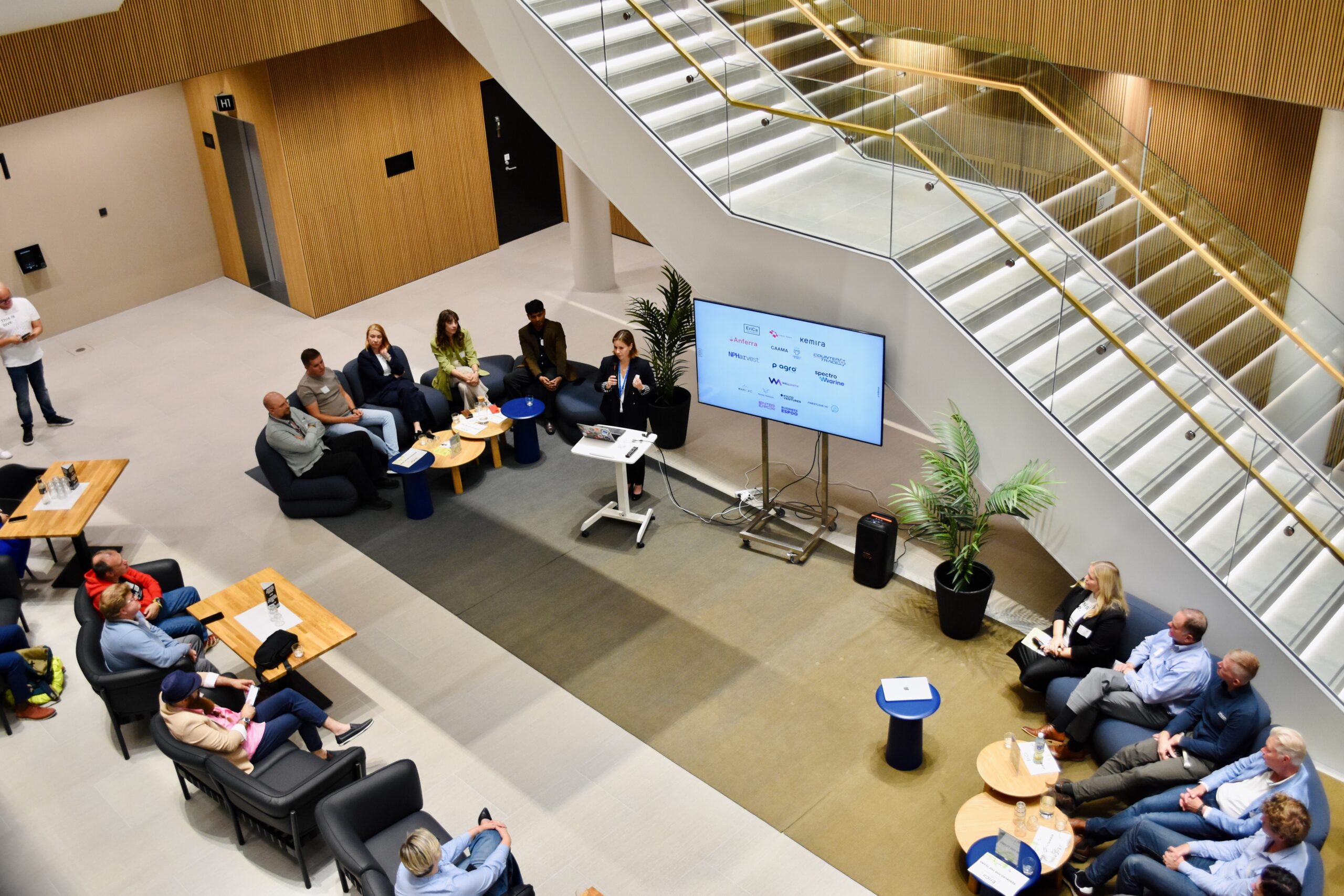
The first cohort ran from March to August 2026 and brought together seven startups and research-based teams developing clean water solutions from five countries:
- Anferra, Sweden
- CAAMA / University of Oulu, Finland
- Countertrace, USA
- NPHarvest, Finland
- P-Agro Minerals, Latvia
- Spectromarine, the Netherlands
- Wellmatix, South Korea
The aim was to help the teams move from lab to market — towards industrial validation, pilots, customers and commercialization.
During the five-month program, teams received 1:1 coaching from Kemira experts, peer support, facilitated workshops, investor introductions and access to the EriCa ecosystem.
The first results suggest that the value was not only in individual meetings or workshops. For many teams, the collaboration changed what they decided to focus on next.

From pilot ideas to concrete validation plans
For several teams, one of the main goals was to prepare for industrial-scale testing and piloting.
Working with industry experts helped turn high-level pilot ideas into more concrete validation plans. Teams received support in defining what data industrial partners would need, which KPIs and technical specifications should be monitored, how results should be analyzed, and what would need to be demonstrated before moving forward.
For some teams, this resulted in detailed pilot or prototype validation methodologies. It also helped clarify the right sequence of commercialization activities: whether the next priority should be sales, technical scaling, validation or collecting further data for future customer discussions.
That kind of clarity can be highly valuable in deep tech development. It helps teams understand not only what to do next, but also what may still be too early to pursue.
Sharper market focus and stronger business models
Technology development is only one part of commercialization. Teams also need to understand where their technology creates the most value and which applications are worth pursuing first.
During the program, teams worked on their market position, value proposition, customer needs and priority applications. For some participants, this meant narrowing down a broad set of potential use cases and focusing on the ones with the clearest customer need and commercial potential.
The collaboration also supported business model development.
For one team, discussions during the program contributed to a pivot towards a new business model. This raised practical questions around customer agreements, responsibilities, risk sharing and how to structure an arrangement that works commercially for both parties.
Industry experience provided useful insight into these questions and into what should be considered when negotiating with customers. The goal was not simply to refine a business model on paper, but to develop an approach that could work in real industrial customer relationships.
Access to expertise, industry and investors
For early-stage deep tech companies, access can be as important as advice.
Several teams highlighted that the program helped them build connections and enter conversations that would otherwise have been difficult to access independently.
Investor introductions opened doors to new discussions, while interaction with Kemira gave teams access to technical and industry expertise in areas such as water treatment, chemistry, industrial applications and piloting.
The value was not simply in introducing startups to a large company. The program created a setting where both sides could explore technologies, applications and commercial opportunities in sufficient detail to identify whether there was potential for further collaboration.
At the same time, Kemira was able to explore how its own chemistry and technical expertise could complement the technologies and innovative products developed by the participating teams.
Funding, new capabilities and continued collaboration
The program also contributed to tangible company-level outcomes.
During the first cohort:
- teams secured combined over 2 M€ of financial investments and funding for further piloting and development
- concrete plans for continued development collaboration with Kemira and other industry partners progressed
- a team recruited a new person to lead commercialization
- an international company established a Finnish entity and gained a home base at EriCa
- teams gained new investor, industry and ecosystem connections
 The industry partner learns too
EriCa Reactor is not designed as a one-directional coaching program. The idea is that startups and industry work together, and both sides learn.
For Kemira, the first cohort provided insight into the entrepreneurial mindset and working methods of early-stage technology companies, including agile ways of working, strong focus and energetic and proactive approach to tackle challenges. Kemira gained insights on how startups prioritize activities, engage investors, rapidly test business concepts, and adapt to customer requirements under resource and time constraints.
The collaboration also created opportunities to evaluate how Kemira’s existing chemistries, technical expertise and capabilities could be combined with emerging startup technologies in different water treatment related applications.
The five-month program resulted in concrete plans for continued development collaboration and Kemira sees lots of potential for future projects. More about these collaborations will be shared as the time is right.
What did we learn?
The first EriCa Reactor reinforced the idea the program was built around: Deep tech commercialization does not happen in isolation.
A strong technology is not enough. Teams need real use cases, customer understanding, industrial expertise, technical validation, industrial piloting, funding and access to organizations that can help them take the next step.
For the first EriCa Reactor cohort, the program’s end was therefore not the end of the process. It was one milestone in a longer journey that continues through pilots, development projects, investment discussions and new partnerships.
 Next: renewable fiber-based packaging
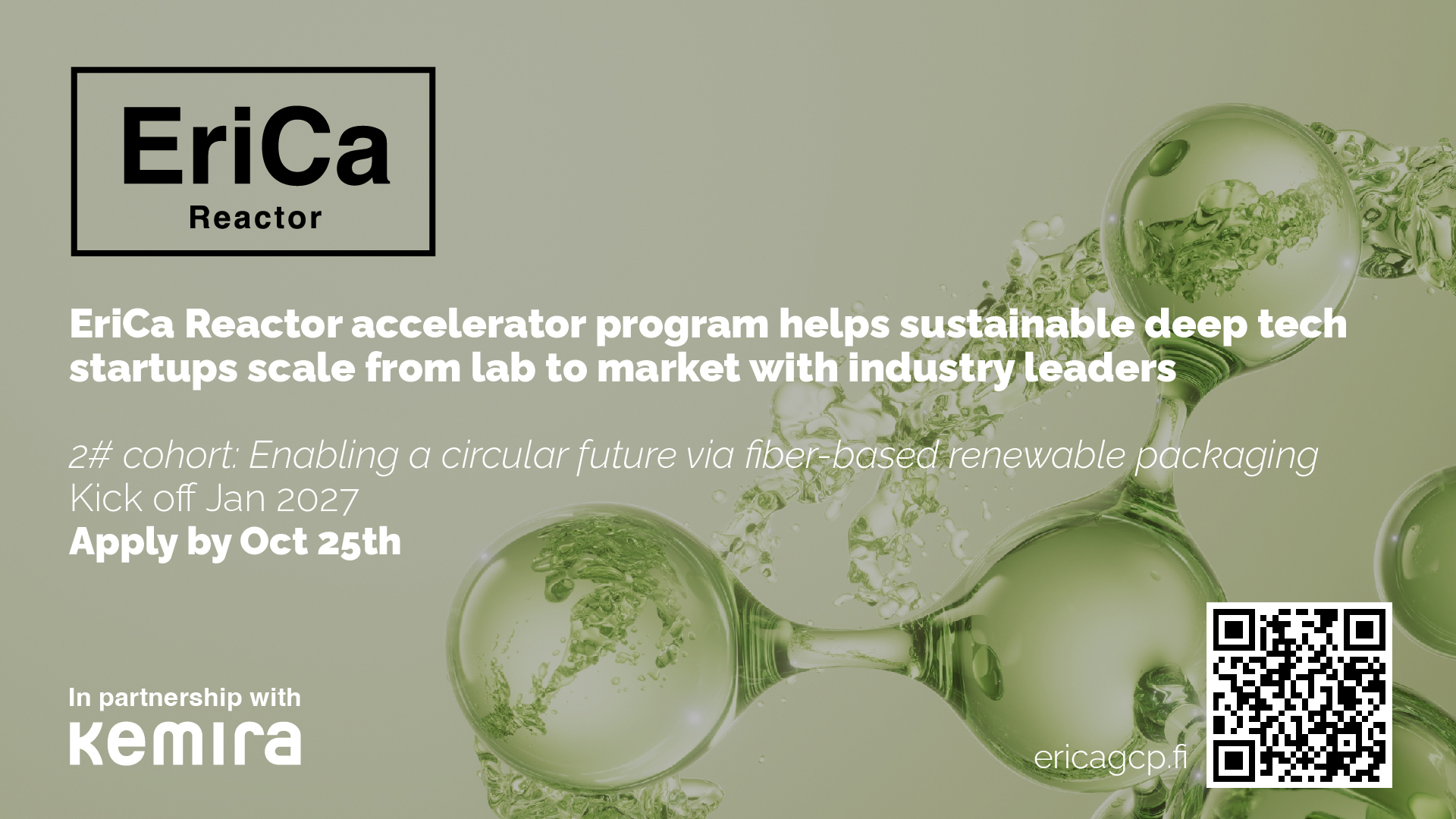
EriCa Reactor is now preparing for its second cohort together with Kemira under the theme:
“Enabling the Future of Circularity with Renewable Fiber-Based Packaging.”
The program is looking globally for 6–8 startups, scaleups and research-based spinoffs developing innovative solutions related to packaging and the fiber industry.
Applications are open until 25 October 2026.
Learn more and apply: https://ericagcp.fi/reactor